

Hello all,
In our last column, I looked at the new tension between moats and speedboats created by AI collapsing time like a car driving over a watermelon… Now I want to address another paradigm shift that is happening as we speak.
For those who have been reading this column for a while, you know I am a devout believer in the power of intangible assets. My entire career — from Microsoft to founding Tangible IP — has been built on the premise that intellectual property is the most valuable asset class of the 21st century. And for fifty years, the numbers have agreed with me.
Ocean Tomo’s famous Intangible Asset Market Value Study — the one slide that has launched a thousand pitch decks — just released its 2025 update, and the headline number is as eye-popping as ever: intangible assets now account for 92% of S&P 500 market capitalization, up from a mere 17% in 1975. The “economic inversion,” as Ocean Tomo calls it, has been one of the most dramatic structural shifts in the history of capital markets — a 75-percentage-point swing in a single human lifespan. If you are in the business of buying, selling, or licensing patents, this slide has been your best friend at every conference, every boardroom pitch, and every investor meeting for the past two decades.
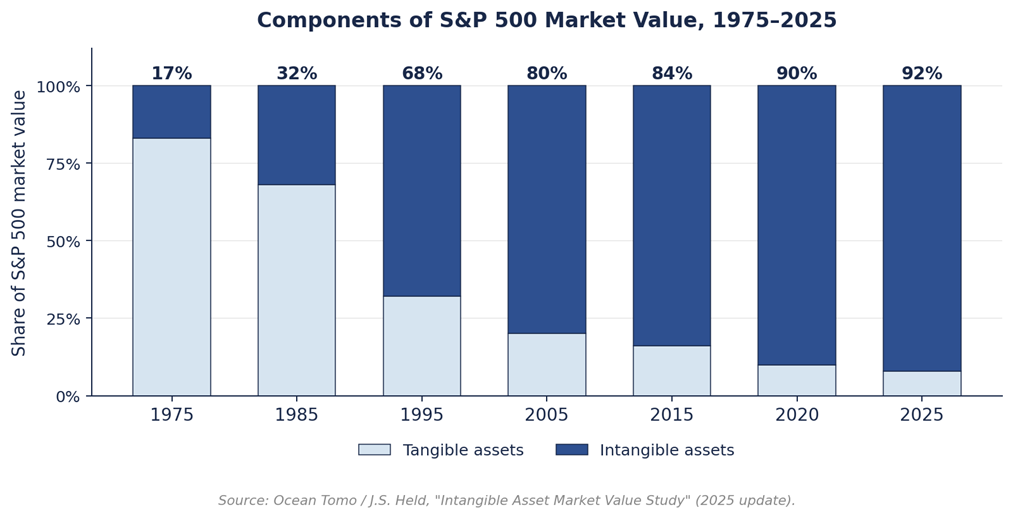
Figure 1. The “economic inversion.” Intangible assets as a share of S&P 500 market value, 1975–2025. Data: Ocean Tomo / J.S. Held, Intangible Asset Market Value Study (2025 update).
I also cover the dramatic shift happening at the PTAB and how this may impact patent owners, at least for the foreseeable future until comes 2028 and a new USPTO director is tasked with undoing everything this is accomplishing. Finally, I cove the latest development at the UPC in Europe as it flexes its pan-jurisdictional muscle.
But here’s the thing about trends that look permanent: they aren’t. And for the first time in half a century, there are credible signs that this particular trend may be approaching a reversal — or at the very least, a significant structural correction. The culprit? Ironically, it is the very technology companies that drove the intangible revolution in the first place. I discuss this below in detail.
As usual, while I focus on the macro picture here, we track everything happening in this space. For a more frequent news fix, you can follow me on LinkedIn, where I post almost daily on noteworthy developments. Links to recent posts are available here.
Happy reading!
Louis
__________________
Tangible IP News
We are pleased to report that we have recently closed the sale of a large VoIP & Data Roaming in Telecommunications patent portfolio. We also just closed on the sale of a 6 patent portfolio in the IoT space. A formal announcement for both transactions will be made in the coming weeks.
Our CEO recently wrote an Oped in the Financial Post on the topic of IP literacy of entrepreneurs. You can read it here. He will also be keynoting the upcoming IP PRIME Conference in Ottawa on June 3, 2026.
__________________
Featured Portfolio
Tangible IP is pleased to exclusively represent Metal Raptor Inc., in the divestiture of their 25 US patents in the UAV-Based Delivery & Air Traffic Control market. This portfolio forms a comprehensive suite of foundational innovations essential for safe and scalable commercial drone delivery, encompassing: Wireless Air Traffic Control, Flying Lane & Waypoint Management, Collision Avoidance & Safety, and Package Delivery Options. The portfolio technology covers critical workflows of drone delivery, adopted by FAA Part 108 & Part 135 rules. Representative Evidence of Use charts have been prepared for 6 US patents showing implementation of the patented technologies by various players in the drone delivery market.
Please reach out to info@tangibleip.biz to receive the marketing materials and additional information.
__________________
When Software Companies Start Building Pyramids
First, consider the numbers. In 2026, the five largest hyperscalers — Amazon, Alphabet, Microsoft, Meta, and Oracle — are collectively projected to spend between $660 billion and $690 billion on capital expenditures, the vast majority directed at AI data centers, GPU clusters, and networking infrastructure. To put that in perspective, this is more than the GDP of all but the top twenty national economies on Earth. Amazon alone plans to spend $200 billion this year — a figure that caught even the most bullish analysts off guard. Alphabet is targeting $175–185 billion. Meta expects $115–135 billion. Microsoft is tracking toward $120 billion or more. Each company’s individual 2026 budget approaches or surpasses what they spent in the previous three years combined. And they are doing this at the expense of the most productive intangible assets creating machines; humans, by laying off tens of thousands of employees to fund their new arms race.
This is not software eating the world. This is concrete, steel, copper, and silicon eating the world. These are physical structures on physical land, drawing physical water from physical aquifers, consuming physical electricity from physical power plants. William Blair’s global strategist Olga Bitel has aptly called it the “Revenge of the Tangibles” — a global investment cycle centered on renewed spending on physical assets and industrial development. After a decade where the lightest, most asset-free business models commanded the highest valuations, the market is now rewarding companies that are building the modern equivalent of railroads, steel mills, and power grids.
The irony is exquisite. The same companies whose soaring valuations created the 92% intangible asset figure are now pouring hundreds of billions into tangible infrastructure — land, buildings, servers, cooling systems, and power generation. When Meta’s Mark Zuckerberg announces a data center “so large it would cover a significant part of Manhattan,” he is not describing an intangible asset. He is describing a pyramid. And like the pharaohs, he is building it because he believes it will secure dominion over a vast territory — in his case, the AI economy rather than the afterlife. (The jury is still out on which bet is more speculative.)
The Great Rebalancing
Now, let me be clear: I am not predicting that intangible assets are about to collapse to 50% of the S&P 500 overnight. But the structural forces at work are real and deserve attention from anyone who advises on IP strategy or patent valuations.
First, the sheer scale of tangible asset accumulation on Big Tech balance sheets is unprecedented. Data center capex grew 57% last year to $726 billion globally and is expected to cross the $1 trillion mark in 2026 — a milestone the industry did not expect to hit until 2029. These are depreciable physical assets — property, plant, and equipment — that will show up in book value calculations for decades. AI assets typically depreciate at around 20% per year, meaning the hyperscalers face an annual depreciation expense of approximately $400 billion by 2030 — more than their combined profits in 2025. When you add $2 trillion in tangible AI-related assets to the balance sheets of the companies that dominate the S&P 500, the denominator in the intangible asset calculation gets a lot bigger.
Second — and this is the part that keeps me up at night — these physical investments are creating barriers to entry that look nothing like the IP moats we have spent our careers analyzing. A patent portfolio creates a legal barrier. A trade secret creates an informational barrier. A brand creates a psychological barrier. A $200 billion data center network creates a gravitational barrier — it bends the competitive landscape around it so completely that smaller players simply cannot escape its pull. When the capital requirement for competing at scale in AI infrastructure makes even Oracle’s $50 billion look inadequate, we are no longer in the realm of intellectual property competition. We are in the realm of who can pour the most concrete and buy the most GPUs. That is a very different kind of moat, and frankly, not the kind that keeps patent brokers in business.
Farmland, Water, and the Cost Nobody Talks About
If the financial implications are striking, the physical ones are sobering. The AI data center buildout is devouring American farmland at an alarming rate. In Oregon’s Columbia River Basin, developers are expected to target 3,000 additional acres over the next decade. In Morrow County alone, between 35 and 40 data centers have already been built on land that was zoned exclusively for farming. In Jerome County, Idaho — one of the state’s most productive agricultural areas, producing roughly $1 billion in farm products annually — tech giants are transforming irrigated cropland into server farms that produce a rather different kind of yield. In central Illinois, where glacial soil produces 234 bushels of corn per acre, developers are offering $60,000 an acre for land worth $15,000 to farmers. One 86-year-old Pennsylvania farmer turned down $15.7 million from data center developers, choosing instead to sell his development rights for $2 million to a farmland trust. “I was not interested in destroying my farms,” he said. That sentiment, admirable as it is, puts him distinctly in the minority.
The water consumption is equally staggering. A large data center can drink up to 5 million gallons of water per day — equivalent to a town of 10,000 to 50,000 people. In Newton County, Georgia, a single Meta facility consumes 10% of the entire county’s water supply. A study by the Houston Advanced Research Center projects that data centers in Texas alone will use 49 billion gallons of water in 2025, potentially reaching 399 billion gallons by 2030 — equivalent to drawing down Lake Mead, the nation’s largest reservoir, by sixteen feet in a single year. In Virginia’s “Data Center Alley,” which handles roughly two-thirds of the world’s internet traffic, data centers now account for nearly 40% of the state’s total electricity consumption. Electricity rates in the mid-Atlantic surged up to 20% in the summer of 2025, driven in significant part by data center demand. Areas with high concentrations of these facilities have seen electricity prices jump 267% over five years.
Think about that for a moment. The intangible economy — the weightless economy, the economy of pure ideas and code — turns out to require an enormous physical footprint of land, water, energy, and concrete. It is rather like discovering that the cloud is actually made of rocks.
The Human Cost: When AI Eats Its Own
Meanwhile, the same companies building these physical empires are systematically dismantling the human capital that once justified their intangible valuations. Nearly 80,000 tech workers were laid off in the first quarter of 2026 alone, with almost half of those cuts explicitly attributed to AI and automation. Block, the fintech company behind Square, reduced its workforce from 10,000 to under 6,000 — the largest single workforce reduction explicitly linked to AI automation in corporate history. Amazon cut 16,000 corporate positions while simultaneously committing $200 billion to infrastructure. Oracle quietly eliminated over 10,000 jobs and redirected the savings to data center funding. As Jack Dorsey put it with unusual candor: “This is not driven by financial difficulty, but by the growing capability of AI tools.”
The pattern is unmistakable: invest in physical infrastructure, divest from human capital. Since early 2022, U.S. job openings have declined from roughly 12.1 million to about 7.7 million — a 36% drop — while the S&P 500’s total return has risen 48%. We are witnessing something that would have been heretical to say five years ago: the most valuable companies in the world are becoming more physically intensive and less human-intensive at the same time. They are building pyramids, but without the labor force that used to justify the pharaoh’s divine status.
What This Means for IP and Patent Valuations
For those of us in the patent market, this paradigm shift demands some uncomfortable questions. If the primary competitive moat in the AI economy is not a patent portfolio but a $200 billion network of data centers and exclusive GPU supply agreements, what happens to the premise that patents are the crown jewels of corporate value? If the barrier to entry is physical rather than intellectual, does the IP premium shrink?
I do not think the answer is as dire as the question implies — but I do think the answer is more nuanced than the patent community has been willing to admit. The truth is that patents remain critically important for the applications built on top of this infrastructure — the algorithms, the model architectures, the specific implementations that differentiate one AI service from another. The drugs that emerge from AI-designed clinical trials will still need patent protection. The semiconductor innovations that make these data centers possible are still patented. The networking protocols, cooling systems, and chip architectures are all covered by vast patent portfolios. The same way I described moats and speedboats in my last column, physical infrastructure and intellectual property are not substitutes; they are complements. But the relative weight is shifting, and anyone doing due diligence on a patent portfolio in 2026 needs to factor in whether the target market’s competitive dynamics are driven primarily by IP or primarily by capital expenditure. In an industry where the top four players are spending $650 billion a year on physical infrastructure, a patent that does not touch that infrastructure may find its leverage diminished.
Here is the related — and less obvious — point. The pharaohs themselves may have surprisingly little reason to bother with patents in the very spaces where their capex is already the moat. Why would Amazon, Alphabet, Microsoft, Meta, or Oracle invest the time, expense, and disclosure cost of building a deep patent portfolio around hyperscale data center architectures, GPU networking topologies, or cooling systems when the realistic answer to “could a competitor replicate this?” is “only with a $100 billion checkbook”? When you already own the only kind of moat that matters — the kind no one else can pour, fund, or permit — bolting on a second moat made of legal exclusivity is largely redundant. (You don’t put a fence around a fortress.) For decades, big tech has filed patents as both offensive ammunition and defensive insurance. In a world where the physical buildout alone deters all but a handful of peers, the marginal value of that insurance shrinks — and with it, the strategic case for filing in the first place.
The other side of this coin is equally consequential. In a world where almost any software solution can now be replicated in days rather than months — courtesy of AI coding agents that will happily ingest, mimic, and improve on a competing product over a weekend — a great many established software businesses are about to be commoditized by AI “agentic wrappers” built at a fraction of the original cost. The functional moat shrinks; the brand moat rises. When the underlying product can be cloned by anyone with a credit card and a half-decent prompt, the asset that retains value is not the code but the name customers trust, the reputation built over years of consistent execution, and the goodwill that survives the wrapper. The intangible percentage of the index may flatten, but inside the intangible bucket itself, the relative weight between patents and brands is quietly shifting — and brand value is enjoying a renaissance most patent strategists have yet to fully appreciate.
A New Chapter, Not a New Book
Let me end with a historical analogy. The original Industrial Revolution didn’t eliminate the value of ideas — it multiplied it. But it also created a period where whoever owned the factories, the rail lines, and the steel mills held disproportionate power, regardless of who held the patents. It took decades for the intellectual property system to catch up and reassert the primacy of innovation over capital accumulation. We may be entering a similar interregnum.
Ocean Tomo’s famous slide is not wrong. Intangible assets do constitute 92% of S&P 500 market value. But that number has been steady at roughly 90% for five years now — the relentless upward trajectory of 1975–2020 has already flattened. If $2 trillion in new tangible AI assets hit the balance sheets of the index’s largest constituents over the next few years, the intangible percentage could dip below 90% for the first time since 2017. That would still be a world dominated by intangible value. But it would also be the first reversal in the direction of that line in fifty years. And trend reversals, even small ones, have a way of concentrating minds.
For patent owners and IP strategists, the message is not to panic but to adapt. The companies building these physical empires still need patented technology to run them — and the AI applications they enable will generate an entirely new wave of patentable innovation. But the days when you could assume the intangible asset percentage would only go in one direction? Those may be over. The Cloud, it turns out, has a foundation. And that foundation is made of concrete, copper, and a rather alarming amount of water.
__________________
Free-Fall at the PTAB
For those who have read this column for a while, you know my feelings about the PTAB. Well, the data are finally catching up with the rhetoric. According to Unified Patents’ Q1 2026 report, total PTAB petitions fell to 131 in the first quarter — a 12-year low and a staggering 64.2% drop year-over-year. IPRs alone plummeted 66.3%. Dennis Crouch at Patently-O counted only eleven (11) IPR filings in the four weeks ending May 2 — the lowest 4-week stretch since the system opened its doors in September 2012. Institution rates have collapsed from roughly 65% in October 2024 to about 37% in February 2026, and the Board’s pending inventory has fallen below 2,000 for the first time in twenty years. Call it the Squires Effect, the “settled expectations” doctrine, or just overdue karma — the petition assembly line is finally idling.
Cue the howls. On April 27, Google filed a petition for certiorari in Google v. VirtaMove, asking SCOTUS whether the USPTO may deny IPR petitions based on a patent owner’s “settled expectations” (the VirtaMove patent was 14+ years old when Google pulled the trigger) and whether Article III courts can review such denials at all. The chutzpah is something to behold: the most prolific PTAB user of the past decade — still the #1 petitioner in Q1 2026, by the way — has suddenly discovered due-process concerns precisely as the regime it helped shape starts imposing limits on it. As Molly Metz and Erich Spangenberg put it on IPWatchdog, “the loudest objections come from the same parties that benefited from its earlier design.” Quite.
Meanwhile, capital — and patent challenges — flow to the path of least resistance. Ex parte reexamination requests surged 157.1% year-over-year, and for the first time since the AIA, they have eclipsed IPR petitions outright. Crouch calls it “decimation,” and most of the new volume is third-party, not patentees cleaning up their own portfolios. That said, don’t pop the champagne yet: the USPTO’s new April pre-order procedure (giving patent owners a 30-page free shot at killing a reexam before any SNQ finding) and Director Squires’ growing willingness to vacate already-granted reexams suggest the gatekeeping baton is about to migrate. Net/net: validity challenges are not going away — they are simply being rerouted, and for the first time in over a decade, patent owners are the ones holding the map.
__________________
How Long Is the UPC’s Arm, Really?
The single biggest open question in European patent marketplace economics — how far the UPC can reach beyond its own borders — got considerably more complicated in the past six weeks.
First, in Adobe, OpenAI & Others v. KeeeX (CoA, March 2026), the Court of Appeal overturned the Paris Local Division and held that, where no defendant is domiciled within UPC territory, the court has no jurisdiction over patents in Switzerland, Spain, the UK, Ireland, Norway, or Poland. The Paris LD had cheerfully extended its reach into all six; the CoA brought the hammer down. Reliance on Article 7(2) Brussels Recast (place of damage) keeps you inside the UPC. To reach outside, you need a defendant inside. The free pass is over.
Second, on March 6, the CoA made the first-ever UPC referral to the Court of Justice of the European Union, in Dyson v. Dreame — staying the Spain part of the action while the CJEU answers four questions on whether a German “authorised representative” (required by EU product-safety rules) can serve as anchor defendant to drag a Chinese manufacturer’s Spanish sales into the UPC. Expect 18–24 months for an answer, possibly longer. In the meantime, the Hamburg LD’s new April PI granted Spain on a different anchor analysis but refused to extend to the UK. The geography is now fact-by-fact, not a blanket reach.
Third, the headline case — Fujifilm v. Kodak, which last year produced the first-ever UPC injunction covering the UK — was argued on appeal on March 27 and 30. A ruling from presiding judge Rian Kalden’s panel could land any week. That is the decision that will tell us whether the UK reach survives at the CoA or quietly disappears into a footnote about Article 71b(3).
What does this all mean for the marketplace? Nuance, not headlines. EP portfolios with UPC-territory infringement nexuses — manufacturing, distribution hubs, anchor defendants in Germany, France, or the Netherlands — remain meaningfully more valuable than they were eighteen months ago. Portfolios whose only realistic enforcement targets sit in Switzerland or the UK without an EU on-ramp are decidedly less so. Anyone refreshing valuations should be mapping the jurisdictional touchpoints carefully, not relying on the “UPC = pan-European” shorthand. The arm is real. It is just not infinitely long — and the CoA is in the middle of measuring it. Caveat both venditor and emptor.