
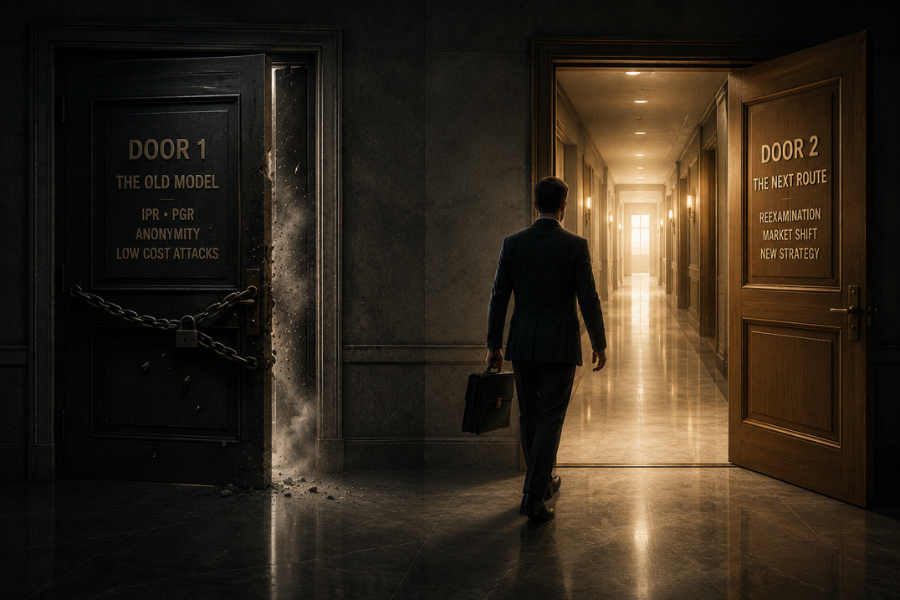
Hello all,
For those of you just back from three weeks somewhere with better weather and worse wifi, last month’s column — Follow The Current — is a good prelude to this one and it will cost you five minutes. The short version: when the Patent Office made it nearly impossible to kill a patent through the front door, the challenges did not stop coming. They found another pipe. This system, I argued, does not reform. It reroutes.
August is what happens next. The rerouting has a price now, and the market has started paying it.
Which brings me to this month’s lead. The most prolific filer of patent validity challenges in American history — an organization built for that single purpose, funded by hundreds of technology companies to do that one thing — sold itself this month to a docketing software vendor. It did so thirteen days after the USPTO proposed the rule that would have stripped away the anonymity its entire model depended on. They say nobody rings a bell at the top of a market. Somebody just did, and I do not think many people heard it.
Then three shorter pieces which are the same story told in different currencies. In Texas, a judge found willful infringement, awarded $445 million, found the harm irreparable — and then declined to enjoin anybody; Collision is now asking the Federal Circuit whether eBay was ever good law in the first place. At the Supreme Court, five petitions now ask whether anyone at all may review the Office’s institution decisions, and for the first time they are arriving from both sides of the table. And in the market itself, patents are moving again at real prices — Dolby, Circle and OpenAI each wrote checks this month for portfolios their sellers had quietly given up on.
Four stories, one thread. For fifteen years, the standard answer to an inconvenient patent was to attack it cheaply and administratively, and a great deal was built on that assumption — business models, valuations, litigation budgets, entire companies. That era is ending. The people with the most money at stake have stopped waiting for anyone to confirm it.
As usual, while I focus on the macro picture in this newsletter, I want to remind everyone that we track everything happening in this world on a daily basis on LinkedIn, where the breaking news lives.
Happy reading!
Louis
__________________
Tangible IP News
For years, we have received several daily inquiries from patent owners hoping to monetize their assets, and for years we have had to decline most of them — not because the inventions lack merit, but because the patents themselves are rarely ready for the market, and nobody had ever told their owners why. We are now fixing that.
Starting this month, Tangible IP offers an in-depth Patent Assessment: an independent, plain-language evaluation of your patent(s) — issued or provisional — graded on the criteria that buyers, licensees, and litigators actually apply. Each assessment covers ownership and legal status, claim quality and likely construction (including how the examination history shapes what you can enforce), validity and eligibility risks, whether infringement could realistically be detected and proven, ease of design-around, what can still be fixed — reissue, reexamination, continuation strategy, and the deadlines attached to each — and the commercial outlook, closing with concrete, prioritized and actionable recommendations. It is offered with or without an independent prior art search (patents only, or patents plus non-patent literature); we invariably recommend the full search, since it is the one an opposing party would run anyway.
To be clear, this is an objective diagnostic, not a valuation from a firm that knows what makes patents valuable…or not. Its job is to tell you honestly whether your patent justifies further investment toward your long-term business or monetization goals, and exactly what to do next. Sometimes the most valuable advice is knowing what not to spend money on.
Inquiries: info@tangibleip.biz.
__________________
Irreparable, Up to a Point
Judge Gilstrap found that Samsung willfully infringed Collision Communications’ U.S. Patent No. 7,593,492, and handed down $445 million. He then found that Collision was suffering irreparable harm, and that money could not fix it. And then he denied the injunction anyway, on the ground that stopping Samsung would hurt Samsung more.
Read that sequence twice. It is not a typo.
Collision filed its opening brief at the Federal Circuit on August 4. The argument comes in two sizes. The retail version: a court cannot find harm it calls irreparable and then decline to repair it, since the balance of hardships will always favor the infringer — the infringer, by definition, is the one making money off the thing. The wholesale version is more ambitious: in 1789, courts of equity treated infringement as ordinarily irreparable, and eBay walked away from two centuries of practice on the strength of about four paragraphs.
Judge Michel has weighed in on Collision’s side, along with a coalition of startups. DOJ and the USPTO filed statements of interest below — which is to say the executive branch has already told the courts where it stands, and did not wait to be asked.
I have argued for two years that the eBay tax has been running for twenty and it is time to repeal it. What I did not expect was that the best vehicle in a generation would arrive gift-wrapped: a willfulness finding, an irreparable-harm finding, a nine-figure verdict, and a denial that reads like a confession.
If the Federal Circuit affirms, it will have to explain how harm can be both irreparable and not worth repairing. I look forward to reading that opinion. And it will likely be appealed to the Supreme Court where I suspect SCOTUS will punt as it always does when it creates a mess around patents that it doesn’t want to fix. Alice anyone? Stay tuned.
__________________
Unreviewable, Party of Five
For a decade, the answer to “can I appeal the Patent Office’s decision to institute — or refuse to institute — an IPR?” has been a flat no. Section 314(d) says those decisions are final and nonappealable, and the Supreme Court has twice declined to find any daylight in that sentence.
The arrangement held, politically, because only one side ever complained. When institution ran near 70%, patent owners howled and nobody listened. Institution has since collapsed — to an all-time quarterly low of 57 petitions in Q2 — and the howling is now coming from the other direction.
There are five cert petitions pending on the same question. Google v. VirtaMove. Intel v. Squires. Tesla v. Granite Vehicle Ventures. An undocketed Kahoot! petition. Four challengers, all furious that the Office will not let them in.
The fifth is the one to watch. Federal Express v. Qualcomm, filed July 31, comes from a patent owner, and the grievance is the mirror image: the Office did institute, and adjudicated to judgment, without ever confirming that everyone standing behind the petition had been named.
So the Court now has a statute that is unreviewable when the agency says yes and unreviewable when it says no, with aggrieved parties on both sides of the aisle holding up nearly identical questions presented. That is not a circuit split. It is something rarer and more useful: bipartisan agreement that the emperor has no appellate wardrobe.
My position here has not moved with the direction of the wind, and I would invite readers to hold me to it. An institution decision that nobody can review was a bad rule at 67%, and it is a bad rule at 9%. The problem was never which way the door swings. It is that there is no handle on either side.
__________________
Everything Must Go
Three transactions reported in three weeks. Taken together they say more about where patent value is heading than any survey I could commission.
First, Dolby paid $37 million for 680 VVC patent assets from Florida Atlantic University and OP Solutions on August 11. Set that against a total 2025 brokered patent market of roughly $158 million (Richardson Oliver), and one university portfolio just moved something close to a quarter of the market in a single afternoon. So much for the notion that university patents cannot be monetized without an act of Congress.
Second, Circle bought nearly 1,000 IBM blockchain patents on July 27 — 680 patent families, price undisclosed — making a stablecoin issuer the largest blockchain patent holder in the United States. IBM spent a decade filing blockchain patents and roughly the same decade failing to build a blockchain business, which is the most IBM sentence I have written all year. Fortune’s Jeff John Roberts asked what Satoshi would make of a decentralization movement captured by government-granted monopolies. Fair question. Mine is duller and more practical: what happens when a payments company with a litigation budget owns the plumbing patents covering its own competitors?
Third, OpenAI quietly bought Rain’s chip patents. The press caught up with this in August. The assignment records tell a better story — four recordations from Rain Neuromorphics to OpenAI OpCo, every one executed October 21, 2025. OpenAI had passed on acquiring Rain, passed on hiring its engineers, and watched the company shed nearly its whole staff. Then it came back for the paper. Rain’s investors received a free education in what a startup is worth once the only strategic buyer learns it can simply wait.
Net/net: patents are being bought again, at real prices, by operating companies with balance sheets. Just not always from the people who thought they owned the future.
__________________
Feature Story: United We Fold
On August 4, Anaqua, the IP software business owned by private equity firm Nordic Capital, announced that it had acquired Unified Patents. Terms were not disclosed. The release uses “proactively” twice and promises to help companies “move from reacting to risk to proactively managing it.”
Strip out the adjectives. The most prolific third-party filer of patent validity challenges in American history – an organization built for one purpose, funded by hundreds of technology companies to do that one thing – sold itself to a docketing software vendor. Its founders took their second payday in seven years. And its data went to a company whose customers include, by its own sponsor’s count, nearly half of the top 100 US patent filers — which is to say, the other side.
Let me be blunt: this is not a software acquisition. This is a market leader closing its own position, and the rest of us should read the ticket.
Unified Patents was founded in 2012 by Kevin Jakel, formerly head of IP litigation at Intuit, with Brian Hinman of InterDigital, who later moved on. Shawn Ambwani arrived in 2013 as COO and has been called a co-founder since at least 2019. Jakel and Ambwani built it, ran it, and have now cashed out of it twice.
The model was genuinely clever, and I have said so for years even while disagreeing with what it did. Companies join a technology “zone” — Cloud, Content, Mobile, Cybersecurity, about a dozen in all — and pay between $50,000 and $490,000 a year. Unified then hunts patents in that zone and challenges the ones it deems weak, or that are being asserted. Think of it as a neighborhood watch that never tells the neighbors when it is going out, never lets them pick the target, and never, ever pays the burglar — that last part being real, and worth crediting.
That architecture was not built for elegance. It was built to take full advantage of a PTAB whose kill rate once ran north of 75%… and to skirt 35 U.S.C. § 315.
The plain-English version of § 315 is this: you get one shot. If the party genuinely behind a challenge has already been sued, or has already lost one of these, it is barred from swinging again. So if Apple is really the one asking, Apple has spent its shot.
Which meant the entire commercial proposition rested on a single sentence: Unified, and Unified alone, is the real party in interest (“RPI”). The zones, the ring-fenced fees, the no-notice rule — all of it is scaffolding around that sentence.
The Party of the First Part
And Unified fought tooth and nail to keep that Potter-esque cloak of invisibility. Across more than a decade and over 300 proceedings, it won every RPI challenge brought against it. Not most. Every one. The Federal Circuit turned away Fall Line, Barkan Wireless and, as recently as June 2025, Dolby. Undefeated is undefeated.
But that record carries an asterisk nobody has paid enough attention to.
In Unified Patents, LLC v. MemoryWeb, LLC, the Board finally did what no panel had done: it took a full evidentiary record, held a hearing on the real-party question alone, and answered it. On March 8, 2023, it found that Apple and Samsung should have been named. Unified had “a strong financial incentive to serve its members’ needs — expressed or not.” And then the phrase that should have made every headline in this industry: Unified had “crafted its membership agreements and its communication protocols with an eye to avoid naming members as RPIs,” a “willful blindness strategy.”
That is a polite judicial term for covering your ears and humming.
Eleven weeks later, Director Vidal vacated it — not because the panel got the facts wrong, but because nothing in that case turned on the question. The finding was erased for being unnecessary rather than untrue.
Apparently, the one time anyone looked closely, they found precisely what patent owners had been alleging for a decade, and the record was then expunged on a technicality.
Meanwhile the courthouse doors had quietly closed from both sides. If the Board decides the question, you cannot appeal it. If the Board declines to decide it, you have no standing to complain. For six years there was simply no way in.
Squires Removes the Furniture
Then John Squires arrived, and the doors began opening… from the inside. Watch the sequence, because the sequence is the story.
In September 2025, Squires stripped precedential status from the very decision Vidal had used to make the MemoryWeb finding disappear. The shield was gone. A month later he restored the older, stricter rule: everyone standing behind a petition must be named before the case starts, and correcting your answer later resets your filing date — a polite way of saying your petition is dead. Patently-O noted that this “impacts membership-based petitioners like Unified Patents and RPX.” It did not need to say more. By February 2026 the Office had welded the last escape hatch shut and begun requiring anonymous reexamination filers to certify they were not the party who had already lost an IPR.
Then came the capstone. On July 22, 2026, the USPTO proposed a rule requiring every third-party reexamination request to identify everyone standing behind it. You may still hide from the patent owner. You may no longer hide from the Office. And for the test of who counts, the Office pointed to the case law asking at whose behest and for whose benefit a challenge was filed — in other words, look at the business model.
Thirteen days later, Unified Patents sold itself…
The comment period closes August 21. Unified will be a business unit inside Anaqua before anyone reads the docket.
The Devil You Knew
Now set the commercial numbers beside the legal ones. They tell the same story in a different language.
When IPR institution collapsed, the challenges did not evaporate — I made that argument here last month — they rerouted into ex parte reexamination. Unified saw it coming and moved early, and by the first half of 2025 it was the largest reexam requester in the country. A year later it had slipped to third, behind Samsung and Apple. It called the trend brilliantly, and then the operating companies walked in and took the room it had found.
And the USPTO is now closing that room too. Reexam requests hit an all-time quarterly high of 336 in Q2 2026 while IPR petitions hit an all-time low of 57. Institution against NPE-owned patents — precisely what Unified exists to challenge — ran at 24.6%, against 40.5% for everyone else. Those numbers come from Unified’s own Patent Dispute Report, published July 9 — four weeks before the sale.
Read that again. Unified published a meticulous, well-sourced autopsy of its own core product, and then sold the company. Where I come from, physicians are usually discouraged from performing their own postmortem and billing for the funeral…
There is a further tell in the paperwork. Anaqua justifies the deal on “escalating IP litigation risk.” Unified’s own July report shows district court patent filings down 18.4% year over year. When the buyer’s story and the seller’s data point in opposite directions, believe the data.
Here I want to challenge my own premise, because intellectual honesty matters more than a tidy thesis. There is a perfectly boring explanation available. WestView Capital Partners took what its own portfolio page calls a majority position in December 2019. That is a six-and-a-half-year hold, and private equity firms do not fall in love — they date on a timetable and always leave before dessert. Membership grew from “over 250” at entry to “more than 300” at exit, about eight net members a year, which is not a story anyone takes to market twice. Sponsors sell. It happens on schedule.
But that explanation proves the point rather than rebutting it. A sponsor sells when it concludes the asset will not be worth more later. WestView did not sell because the clock struck twelve. It sold because it read the same report the rest of us did.
Net/net: this is what retreat looks like when it is wearing a press release.
Whose Interest, Exactly?
Which brings me to the part nobody has written about, and which I suspect will matter more than the transaction itself.
Anaqua sells patent analytics and management software to large patent owners. Unified invalidates patents on behalf of defendants. Those customer bases are not merely different; in a meaningful number of cases they are opposite sides of the same dispute. MLex appears to be the only outlet that asked, and got the answer you would expect: Unified will continue to make independent decisions, and so on. I do not doubt anyone’s good faith. I doubt good faith is the relevant variable. That assurance is not a governance structure, not a firewall, and not a term any member can enforce. It is merely a quote.
Because Unified’s independence was never a matter of virtue — it was a matter of architecture. No member funding, no member notice, no member control. That structure was designed to answer one question from the Board. It says precisely nothing about a corporate parent with a consolidated P&L, or a private equity owner above that parent with a return to generate.
So ask the question the USPTO just wrote into its proposed rule. At whose behest? For whose benefit? Look at the business model — which now includes a parent selling to the patent-owning side of the market. If a Unified reexamination request lands on a patent held by an Anaqua customer, who exactly is the real party in interest, and who decides?
Then there is what Anaqua says it actually bought: “the data, skills and expertise Unified Patents has aggregated over 14 years,” to become “the foundation for an enhanced set of AI-driven Anaqua platform capabilities.” That corpus was built from members’ own exposure — the demand letters they received, the campaigns they faced. They subscribed to a deterrence service. They are now the training set for a product sold to the other side of the table.
Translation: “we are thrilled to welcome the team” means “we wanted the data, and the team came in the box.”
And here is the smallest fact with the largest implications. Unified is a membership organization, and on the day it was sold it posted the acquirer’s press release on its own site, verbatim. No FAQ. Nothing on zone fees, renewals, or what becomes of member data. Three hundred–odd companies appear to have found out about their vendor’s change of control the way the rest of us learn about celebrity divorces.
Nor did anyone in the trade press ask. IPWatchdog, Patently-O and IP Fray — the three outlets that spent a decade interrogating Unified’s structure — did not cover the deal at all, which I find surprising given the implications.
The Bottom Line
For thirteen years, one organization bet that the cheapest way to deal with a “questionable” patent was to kill it administratively, without ever saying who was really asking. It was a good bet for most of those years. It is not a good bet now, and the people who made it have said so in the only language that cannot be spun: they sold.
I wrote last November that it was time to say RIP to IPR. I confess I expected the obituary to come from Congress, or the Federal Circuit, or eventually the Supreme Court. Instead it was written by an investment committee in Boston, signed by a founder taking his second exit, and filed under “Operations” on the company blog.
Somebody finally rang the bell. The only question left is how many people were still at the table when it went off.