
Hello all,
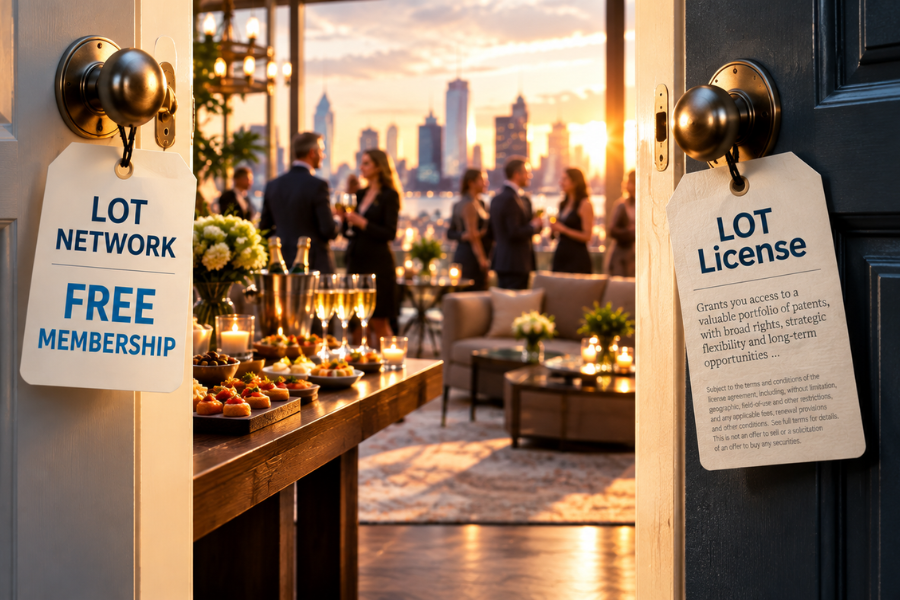
Joining the LOT Network is one of those decisions a startup board makes in about four minutes, mostly because it costs nothing. Very few boards spend a fifth minute on what it does to the patents. With LOT now claiming close to a quarter of active U.S. patents, and Meta, for one, handing out pre-encumbered “non-core” patents to startups since May, it felt like the right moment to read the fine print out loud. This month’s feature explains why a free membership can carry a very expensive price tag at exit, and why the companies that wrote the song are not the ones who should be worried about it.
Two shorter pieces round out the issue, and both are about promises that turned out to be less durable than advertised. On Wednesday morning, IPWatchdog reported that Director Squires is handing institution decisions back to the PTAB, less than a year after taking them, and two weeks after a fee hearing where a retiring congressman made his displeasure known. Meanwhile, the smart money has stopped listening to Washington altogether. SIM IP closed $100 million in insurance-backed financing for campaigns run largely in Europe, and Judge Albright traded the Waco bench for a firm whose patent litigation reputation was built across the Atlantic.
Three stories, one lesson. In this market, the sweetest music usually comes from whoever benefits when you stop reading the terms.
As usual, while I focus on the macro picture in this newsletter, I want to remind everyone that we track everything happening in this world on a daily basis on LinkedIn, where the breaking news lives.
Happy reading!
Louis
__________________
Tangible IP News
We are proud to report that our CEO, Louis Carbonneau, was named one of the World’s Leading IP Strategists for the 14th consecutive year, a very rare feat in the global IP community. Tangible IP is also pleased to report having closed two recent licenses with large industry players in the Live Video E-Commerce area, with at least one more in the works. A formal announcement will follow shortly.
__________________
Featured Portfolio
Tangible IP will soon bring to market exclusively a drone and eVTOL patent estate originating from Top Flight Technologies, the MIT spinout that pioneered hybrid gas-electric multirotor aircraft: 15 issued patents (14 US, 1 JP) across 10 families, plus a live continuation, with priority dates from 2016 and terms running to 2037 and beyond. The portfolio covers two areas where defense and commercial programs are converging: series-hybrid power generation for VTOL aircraft, and UAV navigation along defined air corridors. If you are interested in receiving the materials (including EoU) and are not already on our buyers’ list, please contact us at info@tangibleip.biz.
__________________
Return to Sender
Last November, I asked whether it was time to say RIP to IPR. In May, Act I of our §101 Greek tragedy had Director Squires taming the PTAB. And last month, I argued that Unified Patents sold itself because it read the obituary before the rest of us did. So naturally, this morning, the patient sat up and asked for a glass of water!
IPWatchdog reported a couple of days ago, citing multiple sources, that Squires has told the Board’s judges he will relinquish institution decisions and hand them back to the PTAB. This is the same authority he reclaimed in October 2025. Less than a year. Nothing has been officially announced, and the key details (who decides, under what process, starting when) remain unknown. But the numbers were already moving. By IPWatchdog’s count of USPTO data, institution fell from 68% in FY 2024 to 50% in FY 2025, then to 40% through the first eleven months of FY 2026. In July and August alone, it bounced back to 54%. (The judges, we are also told, may now telework full time. The return-to-office memo was, it seems, discretionarily denied.)
Why now? Follow the money, as usual, disguised as a fee schedule here. Indeed, the USPTO’s fee-setting authority was due to expire this week, and Congress gave it a continuing resolution to mid-December rather than a full renewal, the same way it keeps kicking the can to avoid a government shutdown every 3 months. At the September 2 hearing, Subcommittee Chairman Issa, a well-known friend of the Big Tech anti patents lobby, wondered out loud and not so subtly whether renewal should be conditioned on reining in discretionary denials, and asked whether the Office was not already flush with cash. A former Acting Director proposed requiring written reasons for every institution decision. Squires can read a room, and an oversight hearing is reportedly next without a peace gesture on his part.
Here is what I find remarkable. Issa announced his retirement in March. Tillis who has been championing patent rights at the Senate, is leaving too. One lame duck appears to have bent the Patent Office in two weeks using a routine fee extension. The other, the most engaged patent supporter in the Senate, got PERA its first full committee hearing in July, where Chairman Grassley admitted most members were still studying the bill. No markup. No vote. Because nothing says “legislative legacy” quite like a hearing transcript.
And the back door? Still ajar. A patent owner has asked Squires to terminate a reexam Google filed on the same prior art as its own failed IPR, against a patent that had already survived six PTAB challenges, pointing to 21 similar do-overs. The rule requiring reexam requesters to name their real parties in interest, which I covered last month, is still only a proposal. Put the two together and patent owners face a scenario few modeled: the front door swinging back open while the side door never quite shut.
Let me give the other side its due. The mass denials were opaque, and I said so at the time. Institution decided by panels of judges, with written reasons, is closer to what Congress wrote in the AIA than institution decided by one office working through a checklist of factors. If this produces reasoned decisions, defense counsel will cheer, and they will have a point.
But that is not predictability. That is a pendulum reversing mid-swing. As I wrote last month, an unreviewable institution decision was a bad rule at 67% and a bad rule at 9%. A rule that changes every eleven months is worse than either. Buyers price regulatory risk, and for the past year they have been pricing portfolios, and funders underwriting campaigns, against a PTAB that rarely let challengers in. Nobody’s model had a line item for “the Director changes his mind before the fee bill lapses.”
Let me be blunt: this is not good news for patent owners, and it is worse news for anyone trying to put a number on a patent.
A revolving door lets everyone back in eventually. It just makes it very hard to know which side of the glass you are standing on.
__________________
The Smart Money Has a Eurail Pass
When Erich Spangenberg moves, I pay attention. He has a habit of being where the smart money is going before the money knows it. On September 14, SIM IP closed $100 million in debt financing (a $75 million term loan plus a $25 million delayed draw) backed by a portfolio insurance policy from a syndicate of insurers, giving the lender a second layer of protection on top of the patents themselves. Spangenberg called $100 million “the floor here, not the ceiling,” and says he is talking to long-term capital looking to deploy $1 to 3 billion into the asset class over three to five years.
This is genuinely good news. Insurance turns a lumpy, binary asset into something a credit committee can underwrite. That is a change in capital structure, not a line item.
Now look at where the campaigns are. SIM IP affiliates have been suing Infoblox, Samsung and Microsoft at the UPC. Insurers do not underwrite hope. They underwrite predictability, and this week the UPC’s Munich Local Division showed what that looks like by enjoining Netflix’s streaming software across 18 countries. The smart money has not given up on patents. It has simply stopped waiting for Washington.
Meanwhile, back home, 214 companies, Amazon, Google, Microsoft, Meta and OpenAI among them, wrote the federal rules committee on September 14 demanding mandatory disclosure of litigation funders, and explicitly rejecting disclosure to the judge alone. Translation: “judicial integrity” means “please send us the other side’s budget.” I remain skeptical. The well-capitalized platforms will absorb it. The inventor with a single funded case is the one who gets priced out.
If you want one image for the whole trend, here it is. Judge Albright, whose Waco courtroom was at its peak the busiest patent docket in the country, retired on August 31 and joined A&O Shearman the next day, a firm whose patent litigation reputation was built mostly in Europe. The architect of the most attractive US venue patent owners ever had now hangs his hat at a firm whose center of gravity sits across the Atlantic. That says it all.
In June, I wrote that the answer was not to find the next Albright but to build a system that does not need one. We are currently doing neither. Every reversal in Alexandria adds one more variable to the US model, and every variable becomes a discount rate.
Capital, talent and now judges are all heading through the same door. The one in Alexandria keeps spinning. The one to Europe only seems to turn one way.
__________________
Feature Story: The Siren Song of LOT
Ask the board of almost any venture-backed startup whether the company joined the LOT Network and you will often get a shrug. It was free. It came with a nice badge for the website. It sounded like the responsible thing to do. Ask what it did to the patents and the shrug gets bigger. With LOT now claiming close to a quarter of all active U.S. patents, I thought it was time to read the lyrics out loud.
What LOT Actually Is
LOT stands for “License on Transfer.” It was launched in July 2014 by Asana, Canon, Dropbox, Google, Newegg and SAP. Members agree that if any of their patents ever lands in the hands of a patent assertion entity, every other member automatically receives a license to it. The license sits dormant while the patent stays with an operating company and springs to life the moment it crosses over. A poison pill that only activates when swallowed by the wrong customer…
Since then, Amazon joined in 2016, Meta in 2017, Microsoft in 2018, IBM and Toyota in 2020, along with Tesla, Cisco, Xiaomi, Ford and JPMorgan Chase. Samsung, the world’s largest patent holder, signed on in 2025. LOT now claims more than 6,300 members and over six million patent assets, which by its own count puts more than 24% of active U.S. patents under the license. Membership is free below $25 million in revenue and tops out at $20,000 a year.
The devil, as always, is in the definitions. An “Assertion Entity” is one that, with its affiliates, derived more than half of its gross revenue from patent assertion over the prior twelve months, or whose primary activity is assertion. LOT’s FAQ adds a third route: a plan approved by senior management to get there. Assertion requires no lawsuit; a royalty demand will do. A “Transfer” includes an exclusive license or a grant of the right to enforce.
The license is perpetual and covers every patent a member owns or controls at any time during its membership, including applications that issue after it leaves and any continuation or foreign counterpart claiming priority to them. Withdrawing does not undo it for anyone who was a member on the way out. Call it the Hotel California clause…
Finally, I could not find a single reported court decision construing any of this. Twelve years in, the pill has never been tested in a courtroom, and buyers price that uncertainty accordingly.
Who Is Actually Buying?
In today’s market, patents are valued essentially for their assertion value. Who pays for that? Mostly those who intend to assert. A patent that cannot credibly be enforced against the people using it is, to a buyer, a very well-formatted piece of paper. Richardson Oliver’s data shows NPEs acquiring 20% to 50% of brokered packages in recent years. Many others buy directly from patent owners in usually larger transactions. Irrespective of how they acquire patents, in my experience they are the buyers who set the price.
When an NPE looks at a LOT member’s patent, it sees one already licensed, in advance and for free, to 6,300 companies, including many of the deepest pockets in technology, finance and automotive who are most often the likely infringers. The list of licensees loses precisely the names that made the math work. What remains is a campaign against non-members, many of relatively small, with the added thrill of litigating a definition no court has ever read.
LOT’s answer is its own marketplace, launched in 2022, open only to dues-paying members and advertised as a place where you sell to a trusted operating company, not a PAE. Four years on, I could not find a single transaction LOT has publicly credited to it. Translation: “We built a store for your patents and carefully removed the customers most willing to pay.”
None of this means encumbered patents cannot sell. It means they sell slower, sell less often, and sell for less. In a market where most packages never find a buyer, that is not a rounding error.
BigTech’ Clever Play
Let me be clear: none of this is lost on the companies that built LOT, and I mean that as a compliment. Big Tech has long organized itself on the buy side. Through AST and RPX, the largest implementers share market intelligence, syndicate purchases and licenses, and avoid bidding against each other for the same assets. LOT takes the logic one step further. Why buy dangerous patents when you can neutralize millions of them at the source, before they are ever for sale?
For the founders, the trade is rational and made with eyes wide open. They are among the most frequent NPE defendants, rarely sell to NPEs anyway, and whatever they give up on a hypothetical sale is dwarfed by cutting off the ammunition supply. Odysseus wanted to hear the Sirens too. He simply had himself tied to the mast first.
But the model has a catch. A defensive club is only as good as its coverage, and coverage requires volume. That means thousands of startups and SMEs. So the recruiting has been generous. In 2015, Google’s Patent Starter Program offered startups free Google patents and two years of paid LOT dues, on condition they stay in LOT or forfeit the patents. Red Hat and Lenovo followed with their own offers in 2018. Meta has since transferred patents to members joining LOT, Midjourney among them, and in May 2026 launched a program donating “non-core” patents to venture-backed startups. Every one of those gifts arrives already encumbered, and every recipient adds its own portfolio to the pool. Because nothing says “free patents” quite like a license you grant back to everyone else.
What the Brochure Leaves Out
And here is what the recruits are told. LOT’s startup page says “all the traditional uses of patents are unaffected” and that “there is no downside.” Its FAQ asks “Will joining LOT Network devalue my patent portfolio?” and answers “In a word, no,” adding that valuations were declining anyway. I could not find a single sentence anywhere on LOT’s site acknowledging that the encumbrance can reduce what a buyer will pay, and therefore what a portfolio, and potentially a company, is worth.
The departures tell a different story. When OpenText bought Micro Focus in 2023 and declined to join, ending Micro Focus’s membership, a LOT representative observed that “one way OpenText might choose to deal with these patents would be to sell them to a PAE.” When Broadcom’s VMware left in 2024, LOT’s CEO told IAM that “the only reason to withdraw is to enable the sale of patents to NPEs for monetisation.” Apparently the encumbrance is harmless right up until someone tries to get out of it.
So What Do Small Members Get?
Here is where I want to challenge my own premise, and then LOT’s. A study published on LOT’s site, covering NPE suits from 2017 to 2022, reports that over 52% of defendants had revenues under $25 million, and that 61% held no patents at all. For a company with nothing to encumber, joining costs nothing. Fair enough.
But I would take that 52% with a very large grain of salt. AIPLA’s 2023 survey puts the median cost of taking even a case with under $1 million at risk through trial at around $600,000 per patent. No rational NPE, or its funder, spends that, and usually a lot more, chasing a company whose annual revenue may not cover the bill. The study itself shows small defendants faced 1.6 suits on average, against 12.6 for large ones. A headcount of defendants mostly measures volume: shotgun campaigns, customer suits and nuisance demands priced below the cost of defense. Treating that as proof that startups are the prime target is like counting parking tickets to measure the crime rate. And even then, LOT only helps if the asserted patent passed through a LOT member.
Meanwhile, the startup’s patents are often one of the few assets a buyer can diligence, and in a failed exit the buyer at the end of the road is very often an NPE. The “plan approved by senior management” clause adds a twist: a struggling startup that decides to monetize may, by LOT’s own definition, spring the license on itself.
That does not make LOT a bad deal for everyone. It makes it a decision to take after reading the lyrics, not before. Investors should ask about it in diligence; sophisticated acquirers already do. And LOT, if it is as confident in its value proposition as it has every right to be for its large members, should say plainly on its startup page what the tradeoff is.
Net/net: the big ships are tied to the mast and enjoying the music. The small ones are rowing toward the rocks, humming along.