
Hello all,
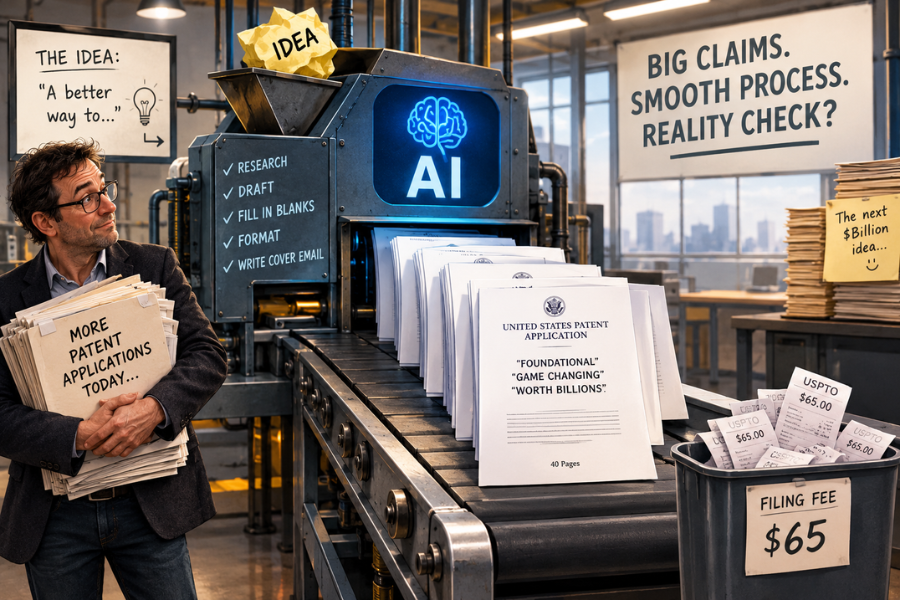
We now receive at least five inquiries a day from a new species of patent owner. Call them the overnight inventors. Somebody had an idea in the shower, typed it into their favorite AI engine, and watched the machine expand it, fill in the blanks, propose a provisional application, draft it, and then, as a finishing touch, write the cover email to us. That email invariably describes a “foundational, game changing platform worth billions.” The machine is nothing if not supportive. (To be fair, mine has never told me an idea was bad either.)
This month’s feature, Stop the Madness, explains why most of these filings are worth roughly what it cost to file them, which can be as little as $65, why many are likely invalid from the day they were filed under inventorship rules here and abroad, and why the valuation on page one of the email would not survive a single phone call from a buyer.
The two shorter pieces happen to be the reality check. The first looks at the PTAB, where Director Squires just told the Senate he is considering handing the merits of institution back to the judges while keeping the discretionary veto for himself. Rules that change every eleven months are a fair complaint for any patent owner. They are no excuse for skipping the one step every inventor fully controls, a proper prior art search, which is precisely the step our overnight inventors never take. The second looks at Taction’s $5.7 billion verdict against Apple, the largest in US history, which I fully expect to start appearing in those cover emails as a comparable. It shouldn’t. In fifteen years of Federal Circuit appeals, no award above $1 billion has survived intact, and buyers know it.
Three stories, one lesson. Value in this market goes to the very few patents that survive the rules and survive the appeal. Everything else is a brochure.
As usual, while I focus on the macro picture in this newsletter, I want to remind everyone that we track everything happening in this world on a daily basis on LinkedIn, where the breaking news lives.
Happy reading!
Louis
__________________
Tangible IP News
Louis Carbonneau is attending the Via Bridge annual conference by invitation, organized by Via Licensing in San Francisco this year. In a few weeks, he will be attending the IP Dealmakers Forum in Austin, Texas in early November. If you would like to meet up, please reach out.
We are also pleased to report we successfully brokered multiple voluntary licenses to a Live Video E-Commerce intellectual property portfolio. The formal announcement with additional details can now be found here.
__________________
Featured Portfolio
We exclusively brought to market a drone and eVTOL patent estate originating from Top Flight Technologies, the MIT spinout that pioneered hybrid gas-electric multirotor aircraft. The portfolio includes 15 issued patents (14 US, 1 JP) across 10 families, plus a live continuation, with priority dates from 2016 and terms running to 2037 and beyond. The portfolio covers two areas where defense and commercial programs are converging: series-hybrid power generation for VTOL aircraft, and UAV navigation along defined air corridors. If you are interested in receiving the materials (including EoU) and are not already on our buyers’ list, please contact us at info@tangibleip.biz.
__________________
Skating on Thin Ice
Every Canadian kid learns the rule before the first skate on a frozen lake. You do not trust the calendar, and you do not trust the thermometer. You drill a hole and measure the ice. The weather is everyone’s problem. The ice under your own skates is yours.
Return to Sender, Again
On September 29, Director Squires told the Senate IP Subcommittee he is considering keeping the discretionary portion of institution decisions for himself and returning the merits to the panels. Translation: “the judges get the merits, I keep the veto.” As former USPTO Solicitor Tom Krause has pointed out, that is essentially Coke Morgan Stewart’s March 2025 bifurcation, now handed to a Board thinned by departures. Meanwhile, the October 2025 proposed rule on discretionary denial sits at OMB after more than 11,000 comments, and the traffic has already rerouted. Per Unified Patents, IPR petitions hit an all-time quarterly low of 57 in Q2 2026 while ex parte reexamination requests set a record of 336. Institution bottomed at 19.4% in August 2025 and was back to 47.4% by June 2026. The forecast now changes faster than the patents do.
Cheap Shots
That matters to price. A patent is worth roughly what someone would pay to enforce it, discounted by the odds that it survives the cheapest credible attack. Think of a house whose title any neighbor can contest for a fraction of what it costs you to defend it. AIPLA’s 2025 survey puts the median IPR through the hearing at roughly $355,000, against about $3.5 million to take a high-stakes case through trial and appeal. Of instituted claims that reached a final written decision, about three in four were canceled (Finnegan’s cumulative tally, so mind the denominator). Reexamination is cheaper still, carries no estoppel, and is ordered more than 90% of the time. Fewer than one in four third-party reexaminations end with every claim confirmed.
I argued in January that the collapse in institution justified higher patent values. The reverse is just as true. Every time the door swings back open, the discount returns. Buyers do not price the rule. They price the odds that the rule changes before they get paid.
The One Thing You Control
The PTAB deserves much of its bad press, and nobody filing today can predict under which memo their patent will be judged. That is weather. But here is where I get off the Zamboni. Most portfolios that cross my desk do not die from the weather. They die because the ice was never there. And the thickness of the ice is the one variable an inventor controls before spending a dollar: a proper prior art search.
The USPTO’s own study of 2021 IPR final written decisions found that 93% of the grounds of unpatentability relied on at least one reference first cited in the IPR, and 74% relied entirely on art the examiner never saw. Yet only 47% of that newly cited patent art fell outside a reasonable examiner field of search. Roughly half was sitting in the obvious neighborhood, waiting for anyone who bothered to look. Examiners get roughly 19 hours per application (Frakes and Wasserman, answering Lemley’s “rational ignorance”), 70% of them told GAO in 2016 they lacked the time for a thorough examination, and nothing in the law requires applicants to search at all. When the Office offered a free AI search before examination through its ASAP! pilot, it drew 169 petitions against a target of 3,200. Apparently, when offered a free look at the ice, most applicants preferred not to know.
Skipping the search compounds. Maintenance fees alone on a US patent carried to full term now total $14,470 at large entity rates. Ten patents come to $144,700, before a dollar of drafting, prosecution or foreign filings. A professional patentability search runs in the low thousands. (For the record, Tangible IP routinely runs such prior art search and analysis, including on non-patent literature, at very competitive pricing. End of commercial.)
The Ostrich Defense
Some practitioners still advise clients not to search, for fear that what they find will feed an inequitable conduct claim. Therasense raised that bar in 2011 to but-for materiality plus specific intent to deceive. Better yet, art you find, disclose and distinguish becomes armor. Under the Advanced Bionics framework, a petitioner relying on art already before the Office must show the examiner materially erred, and a precedential decision designated in 2025 extended that burden to references merely listed in an IDS. And when the search tells you the invention is not new, it has done its most valuable job, hasn’t it?
The rules only decide how cheaply someone can test your patent. The prior art decides whether it passes. So drill the hole before you skate. It is a lot cheaper than the swim!
__________________
The Jackpot Nobody Collects
Every time a lottery jackpot crosses a billion dollars, ticket sales spike. The odds do not improve. The number on the billboard just gets bigger. The patent market runs on the same psychology.
On September 25, a San Diego jury ordered Apple to pay Taction Technology $5.72 billion for infringing two haptics patents covering the Taptic Engine in iPhones and Apple Watches. It is the largest patent verdict in US history, more than double Idenix’s 2016 record against Gilead. Apple said it would appeal. (Apple always says it will appeal. It is the corporate equivalent of “I’ll call you.”)
I can picture my inbox. We review more than five new portfolios a day, and after a headline like this one, the cover emails start doing arithmetic. “My patent also reads on smartphones.” Apple sells hundreds of millions of them. Do the math. Very few hold a $5.7 billion patent, and the ones who come closest are the ones who never mention the verdict.
What the Billboard Leaves Out: none of the nine before Taction survived appellate review intact; exactly one was paid as awarded, VirnetX’s $454 million from Apple in 2020. The rest were erased, cut, or remain stuck on appeal, including VLSI’s $2.175 billion against Intel, now five years old.
This is not anecdote. Bowman Heiden at Berkeley Haas built a database of every patent damages award above $10 million appealed to the Federal Circuit from 2010 to 2025. Of the 82 that reached a decision, only 38% survived intact. Outside biotech, awards above $100 million held up just 10% of the time, and not one award above $1 billion survived. His word for headline verdicts: illusory.
Nobody covers that part. The verdict gets a Bloomberg segment. The opinion that guts it three years later gets buried in a paragraph in Law360. The market hears about every jackpot and none of the refunds. So the record becomes the benchmark in every inventor pitch, while the reversal never makes it into anyone’s spreadsheet.
Even the money behind the case agrees. Burford Capital, whose affiliate financed Taction, told investors on September 28 that it would collect $1.4 billion if the verdict were paid as is. In the same release, it warned the amount will likely change after trial or on appeal, adding that “very few large patent verdicts survive the post-verdict process intact.” Its shares still jumped more than 9% that day. The funder read the fine print. The market bought the billboard.
Big verdicts still matter. They are often the only thing that brings a trillion-dollar defendant to the table, and even a gutted verdict sets the anchor. Carnegie Mellon’s $1.169 billion against Marvell still settled for $750 million. But a deterrent that reliably evaporates on appeal is a scarecrow, and the crows in Cupertino figured that out a long time ago.
The people who actually write checks for patents price the Federal Circuit, not the jury. The entire brokered patent market was roughly $158 million in 2025, according to Richardson Oliver. If mega verdicts moved prices, we would have seen it after VLSI or Caltech. We didn’t. Roughly one in five brokered packages sells, and that ratio has shown no interest in what a jury in Waco or San Diego decided last week.
Their models do not have a line item for “record verdict, pending.” They have a line item for what survives, discounted by how long it takes to find out. (Nobody underwrites a lottery ticket either.)
Prices will move when the Federal Circuit starts letting lower-court awards stand, often enough that a buyer can underwrite the outcome, not the headline. Until then, a jury verdict is a jackpot announced before the drawing has been certified.
Be encouraged by Taction. It proves that seven ordinary citizens can still look at a patent and conclude it was worth something. Some of you may even hold the next one. But the odds much more likely say that you hold the next one of the other nine…
But value your patent on what a buyer will pay today, not on what a San Diego jury awarded someone else. As I wrote last December, the market doesn’t care about your feelings or your valuation report. It cares even less about somebody else’s verdict.
The billboard says $5.7 billion. The fine print gets filed in Washington.
__________________
Feature Story: Stop the Madness
“I am pleased to introduce a foundational, game changing platform that will redefine its industry and is conservatively worth billions.” Some version of that sentence now lands in our inbox at least five times a day. Behind it sits a just filed provisional application of forty immaculately formatted pages, complete with flow charts, a glossary, twenty claims nobody asked for, and a section on commercial applications that reads like a Series B pitch deck. The inventor’s own contribution, when you ask, was usually a paragraph typed into a chatbot over the weekend.
I do not blame the tools. I blame the madness. So let me explain why these filings are worth what they are worth, starting with how value gets made in this market in the first place.
The Five Factors, Again
For those who have been reading this column for a while, you can skip to the next paragraph. For everyone else, we track five factors that move patent values: supply and demand, new case law, the regulatory environment, large damage awards, and funding availability.
This issue covers two of them directly. The PTAB piece is the regulatory environment, meaning whether, and how cheaply, someone can attack your patent. The Taction piece is large damage awards, meaning what a patent can earn if it survives everything else, and how rarely that number holds. Together they explain one of the least appreciated facts in our business. Patent value is log-normal, not normal. The economists who measured it, Scherer and Harhoff among them, found that the top 1% of patents may carry 30% to 40% of all value, while the median patent is worth very little. Our own numbers agree. Roughly one in five brokered packages ever sells (our own batting average is much better I must point out), and only 1% to 2% of the portfolios we review are realistically transactable.
Why so few? Because value only accrues to patents that clear two bars at once: claims that survive the cheapest available attack, and that read on revenue large enough to justify a fight lasting five years and a trip to the Federal Circuit. Taction’s patents needed a reversal on appeal just to reach a jury. Few patents clear one bar. Almost none clear both.
Now run the overnight inventor’s provisional through the same five factors. Demand: buyers acquire issued patents with evidence of use, not drafts. Case law and regulation: the document has never been examined and never will be in that form. Damages: nobody can infringe a provisional. Funding: no funder underwrites a filing receipt. Zero for five.
A Casino in the Backyard
Picture a homeowner who files an application for a permit to build a casino in his backyard, then lists the house at a price reflecting twenty years of projected gaming revenue. Any serious buyer makes one call to city hall and learns the permit will never issue. Zoning, licensing, the state gaming commission, and the neighbors all have a say. The house is worth what every other house on the street is worth.
A provisional, while a valuable step in a long term process to protect a valid invention, is even less than the permit application when it comes to immediate value. The filing fee is $65 for a micro entity. Nobody at the USPTO ever examines it. It lapses after twelve months unless a real application follows, and it cannot be enforced against anyone. “Patent pending,” in this context, carries about as much weight as “casino pending.” And unlike our homeowner’s buyer, a patent buyer does not even need to call city hall. The defects are visible from the curb.
Who Invented It, Exactly?
The first defect is inventorship. In the US, only a natural person can be an inventor. The Federal Circuit said so in Thaler v. Vidal, and the Supreme Court declined to revisit it. Last November, Director Squires rescinded the 2024 guidance on AI-assisted inventions and replaced it with a single standard: AI is a tool, like lab equipment, and inventorship turns on traditional conception.
That sounds generous. For our correspondents, it is anything but. Conception means a definite and permanent idea of the complete and operative invention, not a goal or a wish. “An app that predicts which restaurants I will like” is a wish. If the human supplied the wish and the machine supplied the how, then the how is what the claims cover, and no natural person conceived it. A patent in that position cannot be rescued by swapping names on the cover sheet, because there is no right name to swap in. That is what “invalid ab initio” means in practice: not defeated in court, but never valid in the first place.
Abroad, the line is the same and often firmer. The UK Supreme Court held in 2023 that an inventor must be a natural person, and the EPO, Japan’s IP High Court (January 2025), China’s AI examination guidelines (December 2024) and Switzerland’s Federal Administrative Court (June 2025) all landed in the same place.
Not all agree though; Germany’s Federal Court of Justice held in June 2024 that a human may be named as inventor even when an AI system found the claimed teaching, and the Squires guidance openly welcomes AI-assisted inventing. A real engineer who directs the tool, then selects, tests and refines what it produces, has a credible inventorship story. But the person who typed one paragraph and pressed enter is not that engineer, and the cover email usually says so in its own words.
Written Without Looking
The second defect is prior art, which the first short piece covers at length. These provisionals are drafted with no search at all. Worse, a large language model expands an idea by recombining what has already been published, which is a fair working definition of prior art. If a general-purpose chatbot produced the “invention” from a single sentence, a person of ordinary skill with the same chatbot would have too. A defendant will not have to work very hard on that obviousness argument.
The third defect is the document itself. A provisional secures a priority date only for what it adequately describes. Forty pages of fluent generalities, the kind where “the AI module may determine an optimal outcome,” will not support specific claims a year later, and the priority date evaporates with them.
None of this is unique to patents. A not-yet-peer-reviewed study by researchers at MIT and USC found that 18% of pro se filings (i.e. filed directly by the inventor) in federal court now contain AI-generated text, and Chief Judge Patrick Schiltz of Minnesota has called the flood an existential threat to the federal courts. The Patent Office should not expect to be spared.
Worth Billions?
Then there is the number on the cover email. Investors do pay for patents. A startup’s first patent raises its odds of landing venture funding within three years by 47%, according to Farre-Mensa, Hegde and Ljungqvist. But they pay for issued patents, and the same research shows that issuance itself depends partly on the luck of drawing a lenient examiner. A provisional has not even bought a ticket for that lottery.
And if the largest verdict in US history, $5.7 billion on patents that needed an appeal just to get to trial, may turn out to be a jackpot nobody fully collects, what exactly is a filing receipt worth?
Let me be clear: AI is a superb tool in skilled hands. We use it every day for searching, analysis and drafting, and an inventor with genuine conception who uses it well is in better shape than ever. The madness lies elsewhere. It is substituting the machine’s fluency for the inventor’s conception, and a cover email for diligence.
So, to the overnight inventors: search before you file (or ask us to instead for asking for the moon), write down what you actually conceived and what the machine supplied, and have a human professional tell you what you really have. And before you price the house on the strength of the casino, call city hall.
But first, stop the madness.