
Hello all,
Freshly back from IP Dealmakers in Austin, it felt great to experience this collective sense of relief that things are finally betting better. Although, given that the conference was smacked right during the midterm elections, it was not quite clear what people seemed happy (or not) about and no one risked asking…
Which is just as well, because this issue is mostly about power, who holds it and who is quietly losing it.
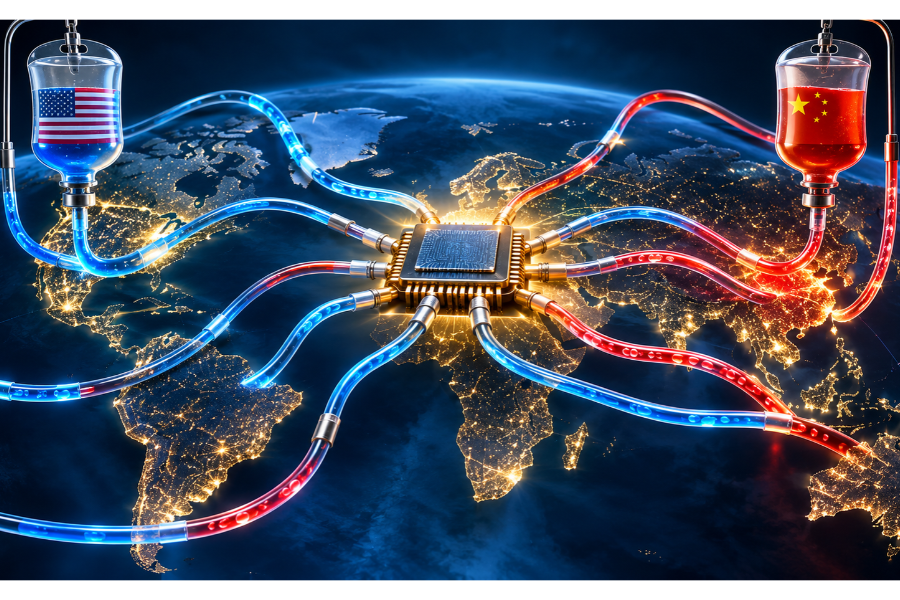
This month’s Feature Story is about the most valuable IP moat ever built, and the geopolitical chess game now being played over it. The Nvidia saga has served up an affair, an alleged honeytrap, a Singapore smuggling probe and a CEO resignation. Underneath the tabloid layer sits a lesson every IP strategist should study: how patents, trade secrets, contracts and a supply chain spanning two dozen countries combined into a dependence that Washington wants to feed and Beijing is desperate to quit.
But first, three shorter takes. In Washington, all three branches shrugged at once. The USPTO handed institution back to the PTAB, the Supreme Court turned away two more §101 petitions, and the midterms left the reform bills without sponsors. (Which may explain the cautious smiles in Austin.) In Europe, the UPC reached across 36 countries in one ruling and denied an injunction over a missed notice in the next. And on funding, the battleground implementers have picked because they cannot stop Europe, insurers are finally coming back to the table.
As usual, while I focus on the macro picture in this newsletter, I want to remind everyone that we track everything happening in this world on a daily basis on LinkedIn, where the breaking news lives.
Wishing you all in the US a happy Thanksgiving holiday in advance.
Happy reading!
Louis
__________________
Tangible IP News
Tangible IP turns 15. Fifteen years ago, I started a patent brokerage firm who’s noble and, many might say naïve goal, was to turn intangible assets into tangible ones for innovators of all walks of life. Hence our name. 2012 was our first full year… and best year ever! Then came the PTAB, Alice and the rest is history. Well, 15 years later, we are still alive and kicking and the environment is finally back to a more reasonable equilibrium, albeit still far from where it should be.
To mark the occasion, we asked a few IP luminaries who are highly respected in our community and who have watched us closely over the years what they really think of us. What a gamble! Remarkably, they all agreed to answer in writing. You can see what the likes of Gene Quinn, Erich Spangenberg, Kent Richardson, Katharine Wolanyk, Reza Mashouf, Bruce Berman, Dan Papst and Yossi Kessler, to name a few, had to say about us here.
__________________
Need Help with Your Christmas Shopping?
We are currently assisting many clients as a buyside broker to facilitate the selection, review, and acquisition of relevant patent portfolios, all while maintaining necessary levels of anonymity. Whether your organization is considering augmenting its portfolio for the long term or needs specific assets quickly, doing it so directly discloses competitive intelligence to others, invites a premium on the acquisition price and may even paint a target over your back unnecessarily. We can help identifying and sourcing high-quality patents and have different offerings depending on your specific needs. Contact us at info@tangibleip.biz for more information.
__________________
Three Branches, One Shrug
Washington gave patent owners a civics lesson this month, with all three branches teaching at once.
Start with the executive. On November 10, Director Squires and his new General Counsel, John Duffy, announced that PTAB panels would again decide merits-based institution starting November 16. The Director keeps the discretionary denial lever, so this is less a retreat than a delegation. The timing is no accident. As we saw last issue, Unified Patents’ Q3 numbers showed the institution rate bouncing back to 57.3%, but on only 96 decisions, while reexams still took 65% of post-grant filings. The front door reopened just as everyone had learned to use the side entrance. (Call it closing the barn door after the horses moved to the reexam pasture.)
The judiciary, meanwhile, declined to answer the door at all. On November 16, the Supreme Court denied cert in Innovaport v. Target and Oasis Tooling v. Siemens, two more §101 petitions returned unopened. After USAA, nobody should be surprised. Apparently, Alice is still somebody else’s problem as SCOTUS has now repeated over thirty times by my latest account.
That somebody was supposed to be Congress. Then came the midterms. Both IP subcommittees now look headed for Democratic control, with Adam Schiff and Hank Johnson expected to take the respective gavels. Senator Tillis, a strong advocate for inventors, chaired his last hearing in September. So PERA, PREVAIL and RESTORE die with this Congress and must be reintroduced in January by sponsors nobody has yet identified. As one colleague put it after IP Dealmakers, the bills come back, the sponsors don’t.
Let me be blunt. The courts will not fix eligibility, the USPTO can only patch it until the next Director rewrites the memos, and Congress will spend 2027 learning what an IPR is. Patent owners waiting for a rescue should look hard at which branch they are leaning on. All three are bending.
__________________
The Long Arm and the Short Leash
Two UPC decisions, days apart, show the court is neither the patentee’s playground nor the implementer’s refuge, which is exactly as it should be. In The Hague, GSK won an injunction against Pfizer and BioNTech’s Comirnaty reaching 36 countries and some 30 defendants, with enforcement deferred. The arm is real, and it keeps getting longer. In Milan, Ericsson proved Asustek infringed, then left without an injunction because it had not given the Huawei v. ZTE notice before filing. It was the UPC’s first successful FRAND defense. Translation: “You may well be right, but you knocked on the wrong door first.” These rulings do not contradict each other. A court that hands out pan-European injunctions must police the conditions attached to them, or nobody will trust it with that power. SEP holders should read Milan as a checklist, not a setback. Net/net, the best patent court in the world just got more credible.
__________________
A Better Insurance Policy
Of the five factors that move this market, patent litigation funding is the one that implementers are now fighting hardest over, and for a simple reason. They cannot control what is happening in Munich, Mannheim or The Hague, so they are going after the fuel instead. The insurance lobby is running consumer campaigns in Texas and Kentucky, more than 20 states already have disclosure laws, Senator Grassley’s Litigation Funding Transparency Act of 2026 is still pending, and a Chamber-led coalition is pushing its House cousin. Meanwhile, the money keeps coming. Omni Bridgeway closed a $1 billion raise with no debt leverage, and investors representing 99% of its prior series came back for more.
Here is the part getting less attention. We are seeing insurers come back to the table, and not a moment too soon. Since Aon’s IP collateral insurance program unraveled with the Vesttoo collapse in mid-2023, there has been next to nothing available, and judgment preservation insurance has faded as well.
This is welcome competition. Traditional litigation funding is expensive because it has to be. The funder takes a non-recourse, essentially unsecured position on an outcome nobody controls, and prices that risk accordingly. Insurance changes the math. Once issued (the premiums run at around 15-20% of the amount underwritten), a policy is bankable. Once the downside is insured, conventional lenders who would never touch a patent case on its own can lend against it, knowing the policy pays if things go awry. More capital, more competition, better terms for patent owners. And since such a policy can be issued directly to the law firm representing the patent owners in order to secure its fees and expenses, it sits outside of the above disclosure requirements that are being pushed to become mandatory, for now at least.
Net/net: implementers can try to starve patent owners of capital. The capital is simply finding another door.
__________________
Feature Story: A Tale of IP Addiction
The Nvidia saga has had more plot twists this year than a streaming spy thriller, and as of last week it has the cast to match. An excentric centibillionaire not named Elon Musk, a mysterious Chinese beauty passing for a tech CEO, etc.; most of the coverage has focused on the affair, the alleged “honeytrap” spy, the Singapore smuggling of chips to China and the resignation of Jensen Huong in Santa Clara. But I want to focus rather on WHAT they are all fighting over: possibly the most valuable legal IP monopoly ever assembled through a long well thought strategy, and the geopolitical chess game now being played over who gets to use it, from Washington and Beijing to Singapore and Taiwan.
Who said IP had to be boring?
Hooked on CUDA
Start with the moat, because everything else follows from it. Nvidia’s dominance is not an accident of good timing. It was built, layer by layer, over two decades. The patents are the visible part, more than 20,000 of them by the latest count. But the real fortress is CUDA (Compute Unified Device Architecture), the proprietary parallel computing platform Nvidia introduced in 2006, back when GPU computing was a hobby for academics and a few eccentric physicists. Nvidia gave the software away, got it taught in universities, and waited. (The first hit, as any dealer will tell you, is always free.) Today millions of developers write for it, and every major AI framework runs best on it.
Around that core sit the layers nobody can download: chip architectures and design know-how guarded as trade secrets, the interconnect expertise Nvidia bought with Mellanox, a manufacturing relationship with TSMC that took fifteen years to build, and a license agreement that prohibits reverse engineering CUDA output to run it on rival hardware. Patents, copyright, trade secrets, contracts and a supply chain spread across two dozen countries, each one covering the gaps in the others. Belt, suspenders, and a second belt, just in case.
The result is lock-in of the most profitable kind. A Shanghai researcher told the South China Morning Post that moving training pipelines from CUDA to Huawei’s alternative adds at least 50% in time and cost. Addiction is a harsh word for a business model, but it is the one that fits. This is the epitome of a legal monopoly built by sound IP strategy, which is precisely why others will go to great lengths to replicate it, legally or not. (China’s antitrust regulator, which has accused Nvidia of violating its anti-monopoly law, might quibble with the word “legal.” It still wants the chips.)
The Opening Gambit
A gambit in chess is an opening move where a player intentionally sacrifices material—usually a pawn or sometimes a minor piece—early in the game for long term gain. Which brings us to the dealer’s pitch. Nvidia’s Jensen Huang told the White House that the best way to keep China hooked was to keep supplying it. Feed China chips that are good enough (i.e. a generation or two behind), and Chinese companies will never bother building their own. Keep them on the American stack, collect the revenue, preserve the dependence. Huang made the case relentlessly, telling anyone who would listen that China was “nanoseconds behind” and that export controls were a tactic that had failed its goal. Picture a dealer lobbying the Drug Enforcement Agency (DEA) for a bigger territory, on national security grounds…
And it worked. In December 2025, President Trump cleared the H200 for sale to approved Chinese customers, with Washington keeping 25% of the revenue… (Because nothing says “national security” quite like a 25% revenue cut!) Keep them hooked!
Gambit Declined
Beijing’s response however came within days and it declined the gambit. Chinese customs agents were told the H200 was not permitted to enter the country, and domestic tech companies were told not to buy. The logic mirrored Nvidia’s, just in reverse: if good enough chips keep you dependent, refusing them is the only way to break the habit. This is corporate tough love at its best, Chinese government style. Just to err on the safe side, Chinese customs even blocked a cut-down Nvidia gaming card that threatened nobody’s AI ambitions, presumably on the theory that a gateway drug is still a drug.
Beijing has since relented at the margins under internal pressure, as Chinese AI labs need these chips to train their models, and even China’s humanoid robots, arguably the best in the world, still think with Nvidia brains. But Reuters reports that about 600,000 H200s are still sitting in Hong Kong awaiting an import approval that has not come. Nvidia now holds a license from one superpower and a stockpile blocked by the other. Approved, it turns out, is not the same as allowed.
Knight Moves Through Singapore
Chinese companies that did not want to wait for their government took the black-market route, and the enforcement record reads like a drug lord’s travel itinerary: servers relabeled in Southeast Asia, Blackwell racks shipped out of Taiwan on paperwork declaring Japan, and banned B300s spotted inside state-owned China Telecom’s network. Every addict eventually finds a dealer who does not ask too many questions.
The biggest name in the file – which no longer needs introductions- is Megaspeed, a Singapore neocloud through which The Information reports at least $7.5 billion of Nvidia hardware moved though it, which is a lot of hardware to file under “miscellaneous”. The DOJ and Commerce have now confirmed a joint investigation. Megaspeed denies any wrongdoing and no charges have been filed. Zooming out, SemiAnalysis estimates that more than 1.5 GW of export-restricted Nvidia hardware has ended up in China in recent years. So much for breaking the habit!
And then the king left the board. Megaspeed was once led by Alice Huang, the alleged “honeytrap” at the center of the Jensen scandal, whom US intelligence reportedly suspects of passing information to Beijing, which China denies. Jensen Huang has acknowledged the affair and resigned last week (although he is now considering a comeback, a move rarely seen in chess). Of all the supply chain risks Nvidia’s board has modeled over the years, this one was not on their Bingo card. Then, Washington moved the very next business day, tightening the rules on both smuggling and offshore chip rentals.
Mind the Gap
So how big is the IP advantage here that is at the core of this geopolitical chess game? While we are now accustomed to seeing products out of China that outperforms everything else, the picture is quite different here; per chip, Nvidia’s new Rubin still delivers roughly 17 to 25 times the performance of Huawei’s best, the Ascend 950. Let this sink… Even the Blackwell Ultras (last generation) turning up in Chinese networks via other illegal imports trail Rubin by a factor of about 3.5. And the H200 that Washington approved and Beijing blocked is roughly a ninth of a Rubin, yet still about double Huawei’s best. Think about that for a moment: the “good enough” chip Beijing is refusing beats anything its own national champion can sell. This is probably America’s last bastion of vast technological superiority, for now.
Huawei’s answer so far -absent the possibility of crossing the moat- has been limited to using brute force, wiring thousands of lower performance chips together and paying for it in power and floor space. But even if the silicon caught up tomorrow, the software would not, and that lock-in is exactly what Nvidia was selling to the White House.
Don’t Bite the Island That Feeds You
You may have read that China can sidestep all of this by designing its own chips and having TSMC manufacture them, exactly as Nvidia does. It cannot. US rules bar TSMC from making advanced AI chips for Chinese designers, a door slammed shut after Canadian based TechInsights’ teardown found TSMC dies inside Huawei’s Ascend processors, ordered through a proxy (that shovel again), and bolted tighter last week. (Time to say: Thanks Canada!)
Which brings us to the supreme irony. For more than seventy years, Beijing has insisted that Taiwan belongs to it. Yet every Nvidia chip its companies crave, whether bought legally, smuggled through Singapore or parked in Hong Kong, was made on that island, and so were the dies inside earlier generations of Huawei’s own chips. By letting its tech sector get hooked, China has turned the island it threatens to invade into the home of its dealer. A blockade would not starve Taipei. It would starve Shenzhen. It is hard to raid the pharmacy when you are its best customer. Nor can anyone rebuild that chain alone: it currently involves companies from about 25 countries directly involved at each stage, with 23 more in support. The world’s most advanced chip is a four-dozen-nation potluck.
The Real Prize
Export controls, in the meantime, have become the US national IP policy by other means, with the government acting as licensing department and collecting a 25% royalty. Translation: “national security” now comes with a rate card.
Having spent fifteen years at Microsoft, I know a platform moat when I see one. I also know that the one thing that drains a moat faster than a competitor is a customer who decides, for reasons that have nothing to do with price, that it will never buy from you again.
That is the real bet. Nvidia wagered that dependence would outlast politics. Beijing is wagering that a few painful years in rehab is a fair price for never needing the dealer again, but has meanwhile developed an addiction of its own, to other people’s IP. Washington, for its part, cannot decide whether it wants China addicted or in rehab, as long as it gets 25% of the dealer’s take.
In chess, the player who runs out of good moves resigns. So far in this game, the only one who has done so is not a country. And he may be asking for a rematch.